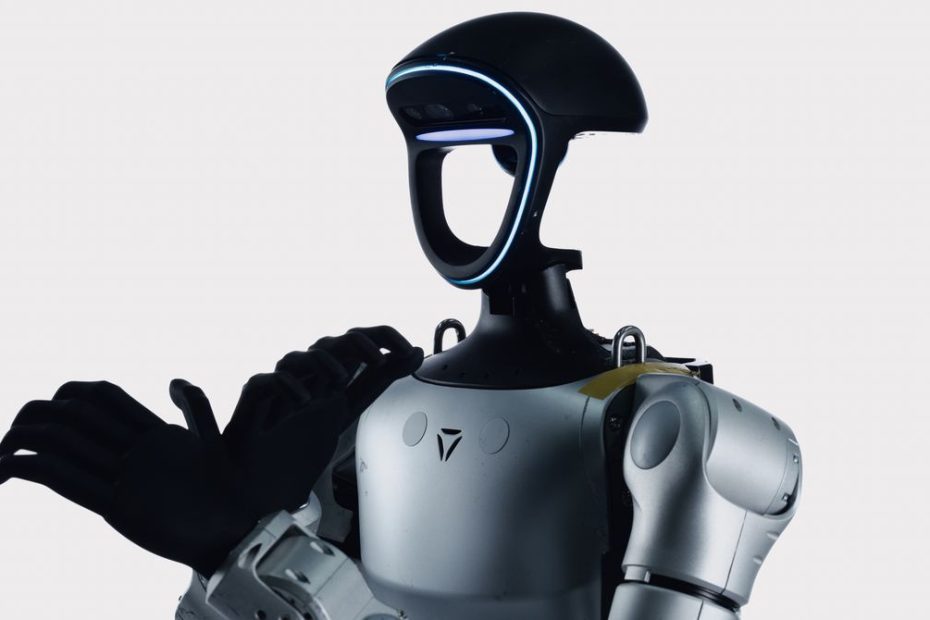
But language models can only do so much, and what robots need most urgently is a new kind of model that understands the physical world the way an LLM understands the written word. And to build that model, engineers need a lot more data. As I walk through BAAI, I see dozens of employees behind desks. They operate various robotic arms and grippers remotely to teach algorithms simple manipulation tasks, such as sweeping up beans on a table, pouring liquids from a jug into different cups, and picking items from shelves. A young man wearing a virtual reality headset appears to be making tea while a camera records his every move. The idea is that with enough training data, robots will intuitively sense how to do all kinds of things without specific training.
The problem is that no one knows exactly what data is most useful to the robots, let alone how much they need or how best to collect it. And for humanoids to become ubiquitous, humans must invent hardware that better mimics a human hand. For a robot, a backflip is a lot easier than tossing a coin.
Still, Tony Zhao, co-founder and CEO of Sunday Robotics, a California-based startup, says he worries that companies like his have little chance against Chinese companies, which can bring in more workers, like BAAI's teleoperators, to train robot models and quickly roll out new hardware. “The speed of iteration is where the US is losing,” he says. “And honestly, I don't know how we can win.”
To keep up, Zhao recently hired an executive from a Chinese robotics company with deep connections and experience in tapping into China's vast and complex supply chain. “The only way we can beat Chinese companies is by building a China team,” he says.
Some US CEOs, including Demis Hassabis of Google DeepMind and Lachy Groom of Physical Intelligence, both chasing the robo-ChatGPT moment, have told me that they envision the development of robotics roughly mirroring that of smartphones, with China making the hardware and the US making the brains. (Except Huawei now makes both.)
The answer might be for the U.S. government to get involved, suggests Jonathan Hurst, co-founder and chief robotics officer of humanoid-making Agility. Among other things, he envisions heavy investments in advanced domestic manufacturing, such as tax breaks for companies that use robots in their warehouses and factories, as a way to keep domestic robotics companies afloat. Such a strategy could begin to mimic the Chinese government's patient capital investments in its industries. “We have to be very smart about automation,” he says. “It's the only way.”
My hotel in Beijing, in the high-tech center of Zhongguancun, did not have the wheeled robots that routinely deliver items to the rooms of some hotels in major cities. Instead, mine had an unfailingly polite human named Stephen. When I needed a shirt cleaned, Stephen completed the job in just a few hours. As I flew home at the end of my trip, I thought about how many hands had washed, pressed, packed and transported the garment back at such speed. Even in China, the robots haven't won yet.
What are you saying?
Let us know what you think of this article in the comments below. You can also send a letter to the editor via mail@CBNewz.