
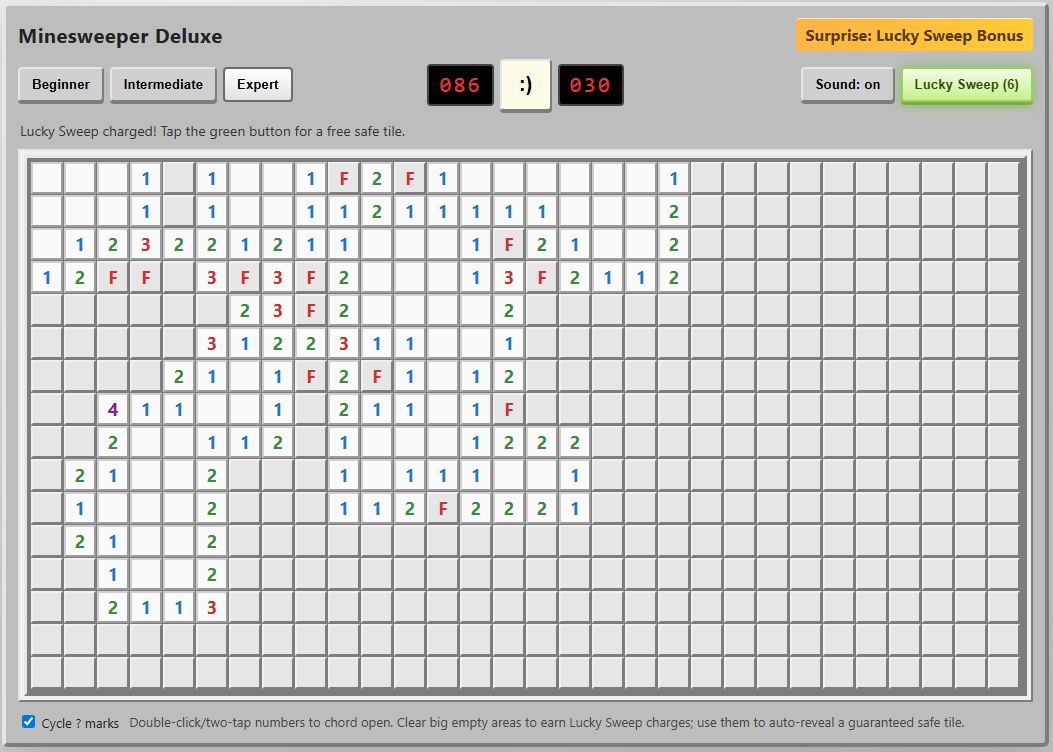
I can't tell you how much I appreciate the chord instructions at the bottom.
I can't tell you how much I appreciate the chord instructions at the bottom.
Credit: Benj Edwards
Execution
This agent not only included the crucial 'chording' feature, but also on-screen instructions for use on both PC and mobile browsers. I was further impressed by the option to scroll through “?” markers when marking squares with flags, an esoteric characteristic that I even feel most human Minesweeper cloners can miss it.
On mobile, the option to hold your finger on a square to highlight a flag is a nice touch, making this the nicest handheld version we tested.
Presentation
The old-school emoticon-smiley-face button is quite endearing, especially when you blow it up and get a red-tinged “X(“. I was less impressed with the playfield “graphics,” which use a simple “*” for revealed mines and an ugly red “F” for highlighted tiles.
The beep-and-boop sound effects reminded me of my first old-school, pre-Sound-Blaster PC from the late '80s. That's generally a good thing, but I still appreciated that the game gave me the option to disable them.
“Nice” feature
The “Surprise: Lucky Sweep Bonus” in the corner of the UI explains that clicking the button will give you a free safe tile, if available. This can be quite useful in situations where you would otherwise have to guess between two tiles that are equally likely to be mines.
Overall, though, I found it a little strange that the game only gives you this bonus after you find a large, cascading field of safe tiles with a single click. It usually functions as a 'win more' button rather than a feature that provides a good balance between risk and reward.
Experience with coding
OpenAI Codex has a nice terminal interface with features similar to Claude Code (local commands, rights management, and interesting animations showing progress), and it's quite pleasant to use (OpenAI also offers Codex through a web interface, but we didn't use that for this evaluation). However, Codex took roughly twice as long to code a functional game than Claude Code, which could contribute to the strong result here.