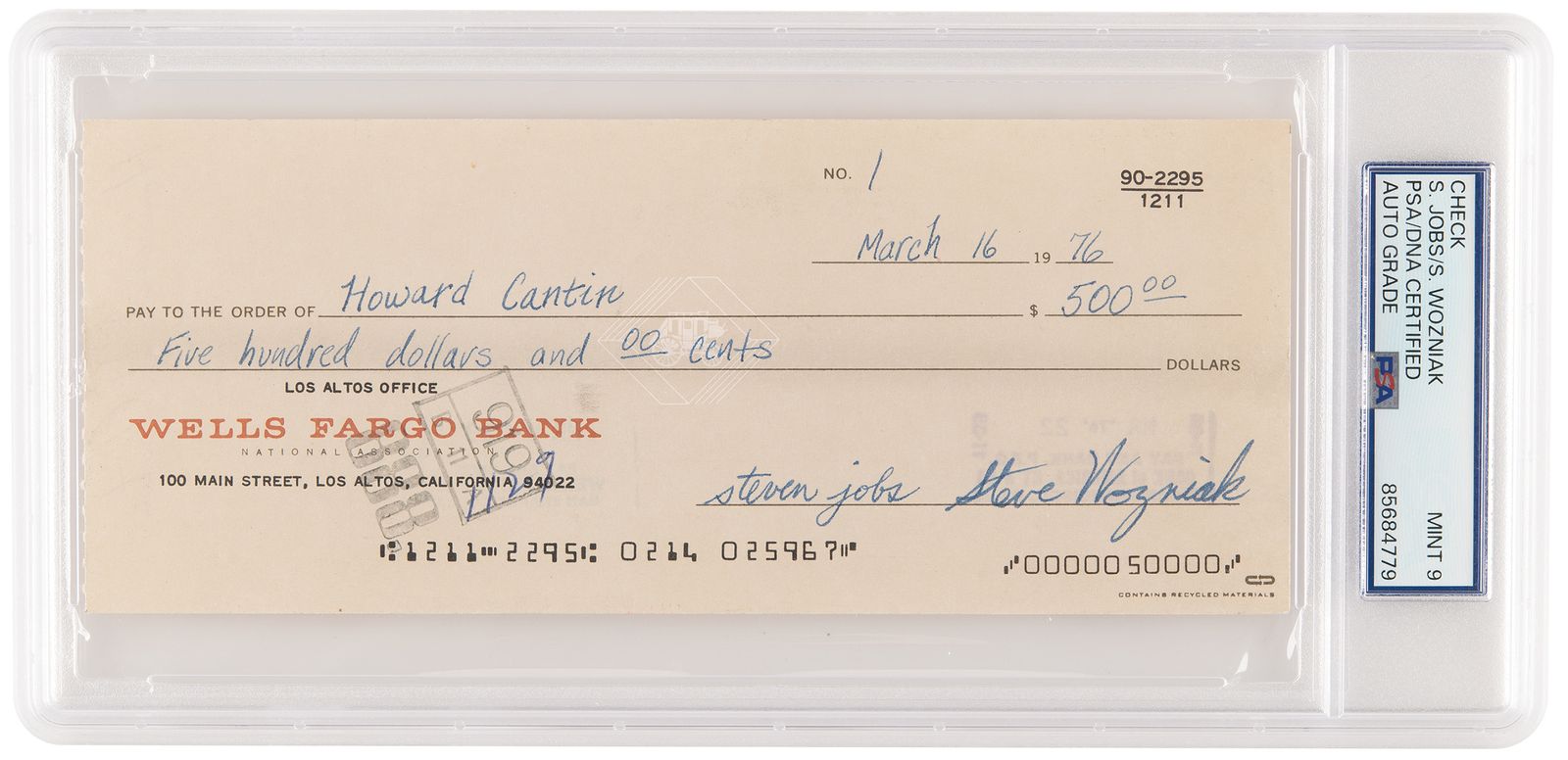
Thanks to RR Auction
Coincidentally, the original partnership agreement between Jobs, Wozniak and Ronald Wayne, signed on April 1, 1976, is also available for inspection at Christie's this month. (Wayne developed cold feet shortly after signing and sold his 10 percent stake to the Steves for $800.) It is among the “works of art, furniture and documents that changed American history” offered in an auction called “We the People: America at 250.” Christie's estimates the partnership document will sell for between $2 million and $4 million.
Articles relating to Apple's early history, especially ones involving Jobs, have skyrocketed to stratospheric prices in recent years. Jobs was known for his reluctance in signing articles, and his signature is considered one of the most valuable of any public figure. Even a signed business card can cost as much as six figures. “There is an emotional connection between Steve Jobs and collectors,” said Bobby Livingston, executive vice president of RR. “People who start their own Internet or engineering businesses love Apple products.” Lonnie Mimms, the owner of Check No. 2 and the founder of a technology museum in Roswell, Georgia, raves about the value of such pieces of paper. “You can get anything in the world with Steve Wozniak's signature on it, but Jobs is a different story. And those two together are the highest form of rarity.”
The items released by Chovanec are in a different domain. Some of them seem to belong less to history than to the domain of religious relics. After Paul Jobs' death, Steve promised that Chovanec's mother could live in the house “until you drop.” Chovanec says the notoriously unsentimental Jobs wasn't interested in anything at his former home except a few family photos. When it came to the desk and its contents, he said Jobs told him to just take it. Chovanec's mother, Marilyn, continued to live in the house until her death in 2019. For years, the desk and other items were stored in Chovanec's garage. He actually worked for Apple starting in 2005 and didn't reveal it to Jobs until after he was hired. During his 16-year stint with the company, first in the supply chain section and then in the retail group, few knew he was Jobs' stepbrother. “I felt like it was nobody's business,” he says. When Chovanec attended Jobs' memorial service at Stanford in 2011, he says, “some executives looked at me like, 'What are You do here?'”