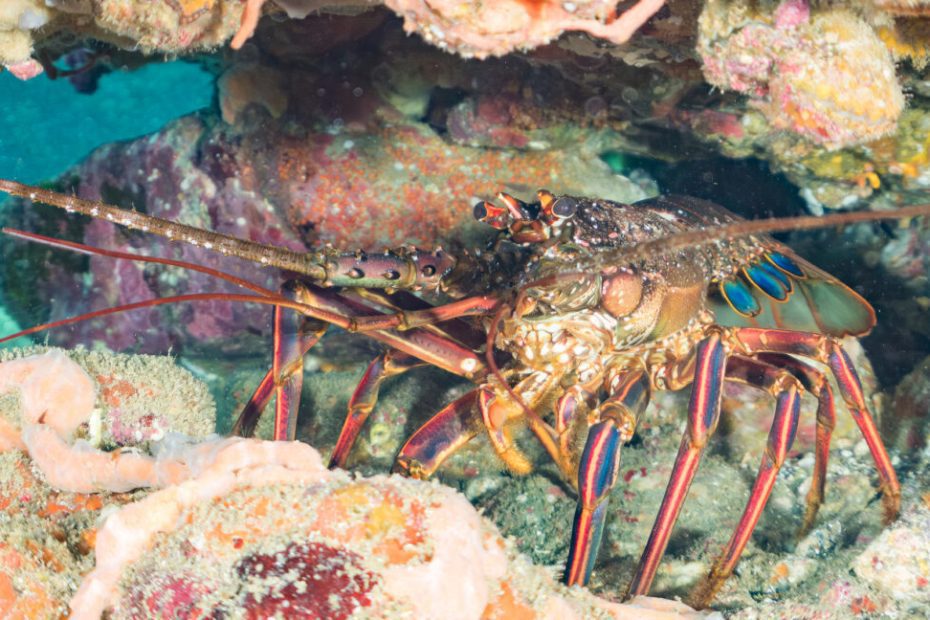
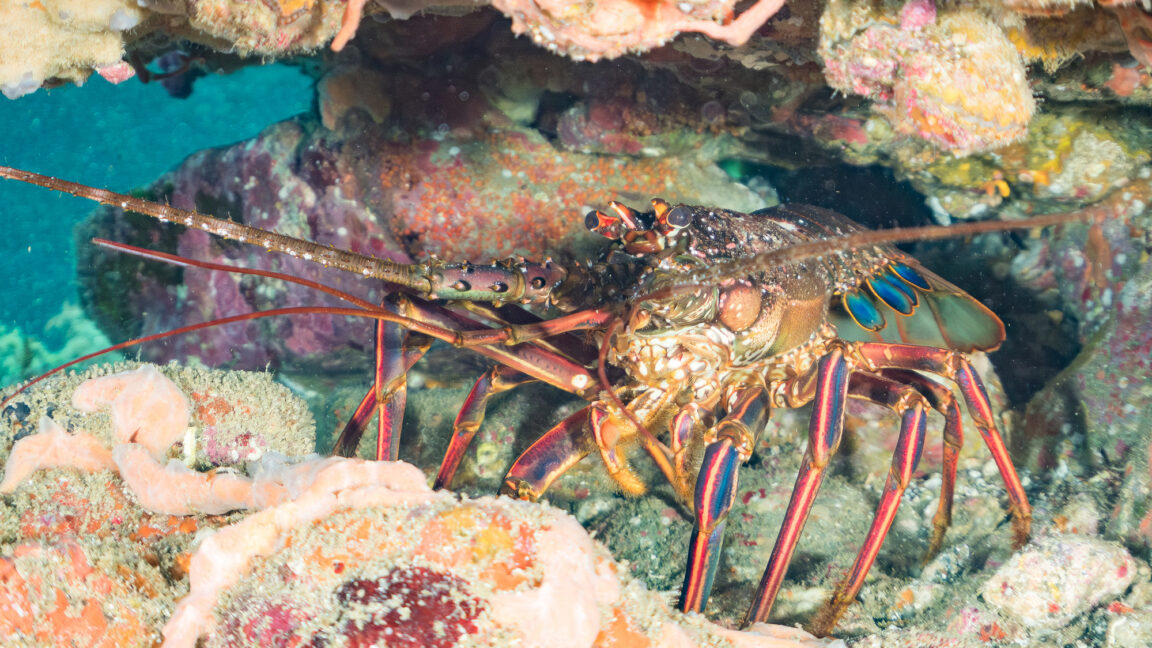
The authors, Mark Butler, Donald Behringer and Jason Schratwieser, hypothesized that these solution gaps represent an ecological trap. The older lobsters finding shelter in a solution hole would release the chemicals that encourage the younger lobsters to congregate with them. But the young would then fall prey to groupers that live in the same solution hole. In other words, what is normally a sign of safety — the signal that many lobsters are present — could lure smaller lobsters into what the authors call a “predatory death trap.”
Testing the hypothesis required many underwater surveys. First, the authors identified solution holes with a red grouper present. They then found a series of locations with an equivalent amount of cover, but without the solution hole and its associated grouper. (The survey lacked a control with a solution hole, but no grouper, for what it's worth.) At each site, the researchers began daily surveys of the lobsters present, recording their size and tagging any lobsters not found in previous surveys. This allowed them to monitor the lobster population over time, as some lobsters can migrate to and from locations.
To combat predation, they linked lobsters (both large and small) via ropes that allowed them to occupy sheltered spots on the seabed but not leave a particular spot. And after the lobster population dynamics were sorted, the researchers caught some groupers and checked their stomach contents. In some cases, this revealed the presence of lobsters that had previously been tagged, allowing them to directly associate predation with the size of the lobster.
Lobster traps
What did they find? At sites where grouper were present, the average lobster was 32 percent larger than the control sites. That's probably because more than two-thirds of the small lobsters tied to spots with a grouper were dead within 48 hours. At control sites, the mortality rate was approximately 40 percent. That's comparable to mortality rates for larger lobsters at the same locations (44 percent) or at locations with groupers (48 percent).