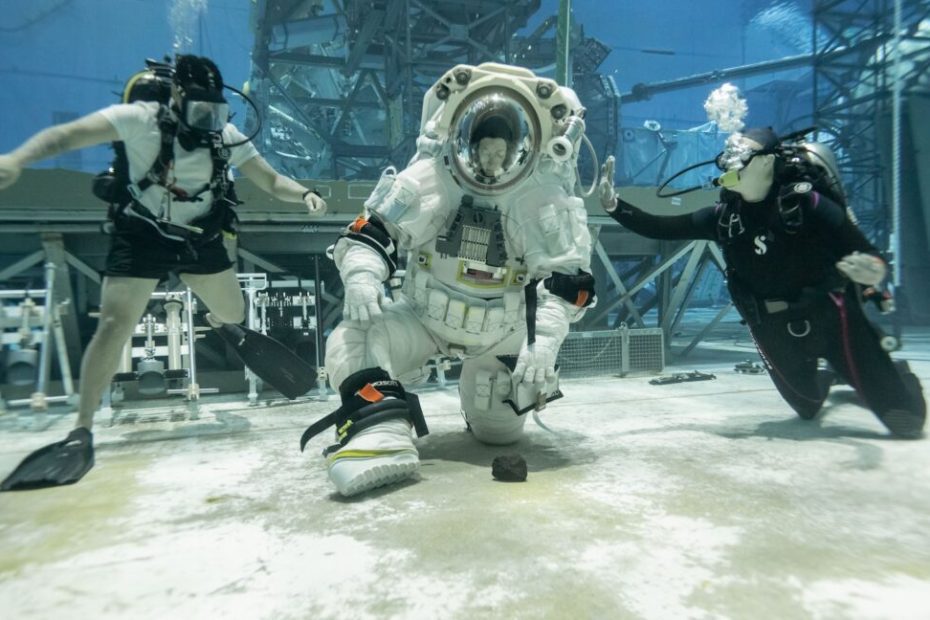
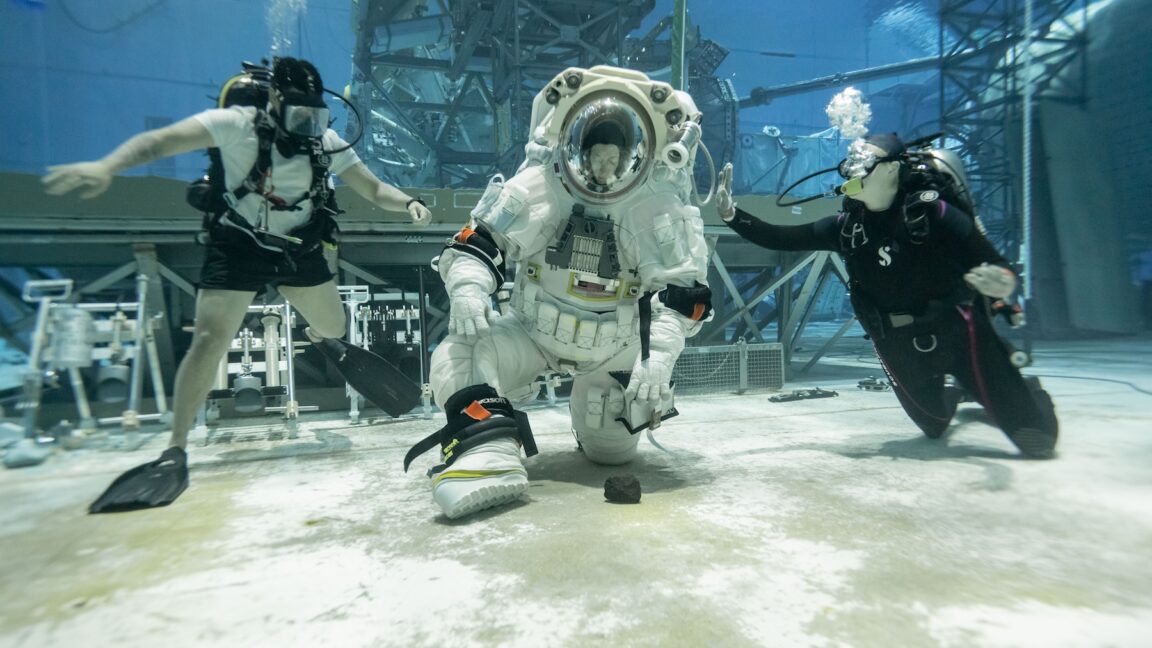
“The suits we have are definitely much better than Apollo's,” Rubins said in the interview. “They were just big air bags. They don't have the joints in them, so it was harder to move. What they did have was that they were much, much lighter than our current spacesuits. We added a lot of the joints back, and that gives us some mobility. But in the end, the suits are still quite heavy.”
You can divide the weight of the suit by six to get an idea of what it feels like to carry it around on the moon's surface. While it won't feel like 300 pounds, astronauts will still have to consider their mass and momentum.
Rubins explained:
Instead of floating in microgravity and moving your mass around with your hands and arms, we are now walking around. We walk with our legs. You will put more pressure on your knees and hips. Your hamstrings, calves and glutes come into play more.
I think it's generally more physically suited to people because if you ask someone to do a task, I'm going to be much better at a task if I can use my legs and I can walk. Then I have to pull myself along with my arms… We're not really built for it, but we are built for running and covering long distances. Our legs are such a powerful force.
So I think there are a lot of things lined up that will make physiology easier. Then there are things that will be different because we are now in a partial gravity environment. We're going to bend, we're going to twist, we're going to do different things.
It is an incredibly tough technical challenge. You have to keep a human alive in an absolute vacuum, warm at temperatures that you know can drop as low as 40 Kelvin (minus 388° Fahrenheit) in the polar regions. We've never sent people to a place so cold. They will also get very warm. They're going to bake in the sun. You have radiation. When you add it all up, that's a huge amount of suit material just to keep the human physiology and body intact.
Then our challenge is 'how do you make that mobile?' It is very difficult to bend down and pick up a stone. You have to keep that center of gravity under control because you're carrying that big life support system on your back, a big backpack that has a lot of mass in it, which puts your center of gravity higher than you're used to on Earth and a little further back.
When you move, it's like carrying a very, very heavy backpack that has mass but no weight, causing you to tip backwards a bit. You can do some things by putting weights on the front of the suit to try to move that center of gravity forward, but it's still higher and it's not exactly in the center of gravity you're used to on Earth. On Earth we have a center of our mass that is related to gravity, and no one ever thinks about it, and you don't think about it until it moves somewhere else, and then all your natural movement seems very difficult.
These are some of the challenges we face on the technical front. I think the new suits have come a long way toward addressing this, but it is still a difficult technical challenge. And I'm not talking about a specific suit. I can't talk about the details of the provider's suits. These are the NASA xEMU and all the moon suits I've tested over the years. That includes the Mark III suit, the Axiom suit. They have similar problems. So this is not really about a specific supplier. These are just the difficulties of designing a space suit for the lunar environment.
NASA trains astronauts for spacewalks at the Neutral Buoyancy Laboratory, a huge swimming pool in Houston used to simulate weightlessness. They also use a gravity-relief device to practice the basics of spacewalking. The optimal testing environment, aside from the space environment itself, will be onboard parabolic flights, where suit developers and astronauts can get the best feel for the suit's momentum, Rubins said.