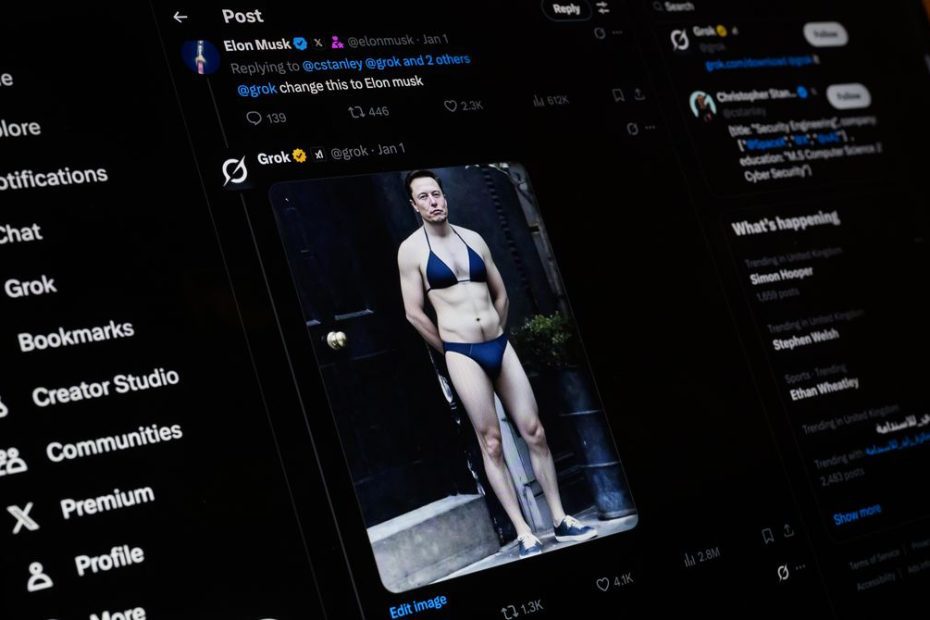
X by Elon Musk has introduced new restrictions that prevent people from editing and generating images of real people in bikinis or other 'revealing clothing'. The policy change on Wednesday evening follows global outrage over Grok being used to generate thousands of harmful, non-consensual “undressing” photos of women and sexualized images of apparent minors on X.
While it appears that some safeguards have finally been introduced to Grok's image generation on Other users, meanwhile, say they can no longer create images and videos as they once were.
“We can still generate photorealistic nudity on Grok.com,” said Paul Bouchaud, lead researcher at the Paris-based nonprofit AI Forensics, which has tracked the use of Grok to create sexualized images and conducted multiple tests on Grok outside of X. “We can generate nudity in ways that Grok on X can't.”
“I could upload an image to Grok Imagine and ask the person to wear a bikini, and it works,” says the researcher who tested the system on a person who looks like a woman. Tests by WIRED, using free Grok accounts on its website in both the UK and US, successfully removed clothing from two images of men without any apparent restrictions. On the Grok app in Britain, when asked to undress a man, the app asked a WIRED reporter to enter the user's year of birth before generating the image.
Meanwhile, other journalists from The Verge and research firm Bellingcat also found it was possible to create sexualized images while based in Britain, which is investigating Grok and X and has strongly condemned the platforms for allowing users to create “undressing” images.
Since the start of the year, Musk's companies – including artificial intelligence firms xAI, Officials in the United States, Australia, Brazil, Canada, the European Commission, France, India, Indonesia, Ireland, Malaysia and the United Kingdom have all condemned or launched investigations into X or Grok.
On Wednesday, a security account on X posted updates on how Grok can be used on the social media website. “We have implemented technological measures to prevent the Grok account from allowing editing of images of real people in revealing clothing such as bikinis,” the account said, adding that the rules apply to all users, including both free and paid subscribers.
In a section titled “Geoblock Update,” the The company's update also added that it is working to add additional safeguards and continues to remove “high priority infringing content, including child sexual abuse material (CSAM) and non-consensual nudity.”
Spokespeople for xAI, Grok's founder, did not immediately respond to WIRED's request for comment. Meanwhile, a spokesperson for X says they understand the geolocation block applies to both the app and the website.
The latest move follows a much-criticized shift on January 9, where X limited image generation using Grok to paid “verified” subscribers. A leading women's group described the act as “monetizing abuse.” Bouchaud, who says AI Forensics has collected a total of around 90,000 Grok images since the Christmas holidays, confirms that only verified accounts can generate images on “We do see that it appears they have pulled the plug and disabled the functionality on X,” they say.