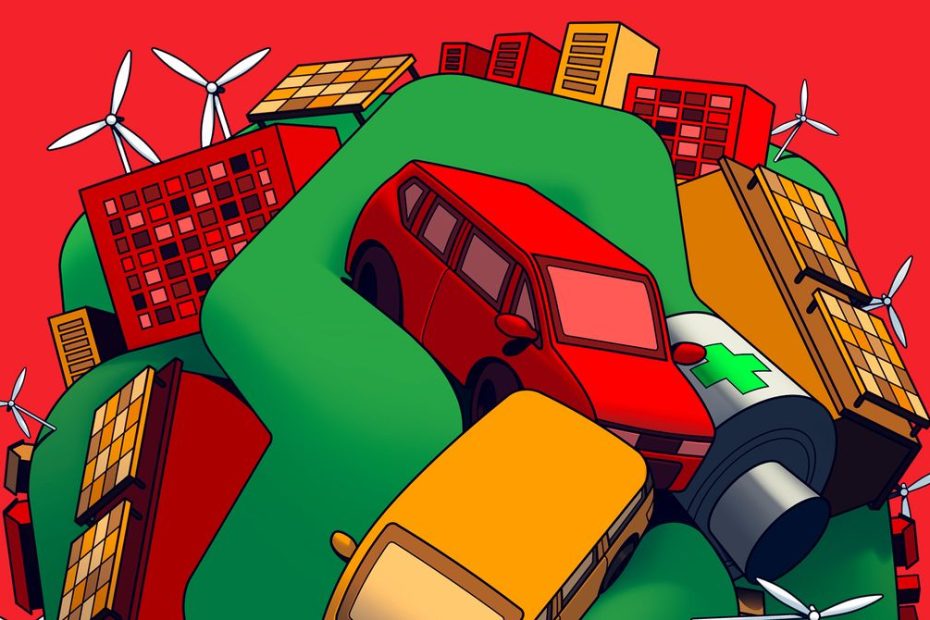
THE symbolism was evident last June when Emmanuel Macron, surrounded by factory workers, held a sleek lithium battery in his right hand and a mining lamp in his left. He was in Douai, a northern French town with a mining history dating back to the 18th century. The city is now also the site of a battery factory, which would allow France to produce all electric vehicle components domestically. This factory, Macron declared, represented an “economic and ecological revolution.”
Macron immediately acknowledged that France had not done this alone: ”We brought in investors from the other side of the world. They transferred their technologies. They helped train people,” Macron said, gesturing to a man next to him.
The man was Zhang Lei, the founder of Envision, a leading Chinese company that makes wind turbines and lithium batteries. The battery division is investing up to €2 billion in this factory in Douai and, more importantly, has brought in the expertise for efficient mass production. He and Macron took markers and signed their names on the first battery produced in Douai. “Thank you, President, for trusting us and for doing exactly what you said you would do,” Macron said, looking Zhang straight in the eye.
In 2026, it's okay to nerd out about batteries at parties. Lithium batteries turn solar and wind energy into 24/7 stable energy sources. Battery-powered cars are shaking up the billion-dollar auto industry and have made Elon Musk the richest man on earth. Lithium batteries have even won a Nobel Prize, and the US government now categorizes lithium as a “critical mineral.”
The rising tides of Lithium lifted one group of boats more than others: the Chinese battalion of battery companies. After decades of quiet growth, companies like CATL, BYD, Gotion High-Tech and Envision are now the leading suppliers for the world's electric cars and energy networks. According to the International Energy Agency, more than 80 percent of the world's battery cells would be produced in China by 2024. Now these companies are expanding beyond China's borders. Over the past decade, they have built or announced at least 68 factories outside China, according to data collected by WIRED and the Rhodium Group, a New York-based think tank.
According to the Rhodium Group, the factories collectively represent an investment of more than $45 billion in the rest of the world. They also reflect a major shift in what dominance in manufacturing looks like. “Made in China” used to be (and often still is) a label for cheap labor, counterfeit products, and $5 gadgets. Now it also means the most modern technology, anywhere in the world.
“We believe this is a new phase. We've never really seen that in Chinese foreign investment,” said Armand Meyer, senior research analyst at Rhodium Group. By his calculations, 2024 was the first year that Chinese EV and battery companies spent more money building factories outside China than inside. “They are ready to exit the domestic market and are as competitive as traditional Western players, if not more so,” Meyer continues. “We think this is just the beginning.”
Today, some of the world's best battery research comes from Chinese universities and companies, says Brian Engle, president of NAATBatt International, a U.S. trade association for the battery industry. And that's because China gambled on it early on.
When Engle visited a laboratory at China's top engineering school in 2019, he saw more than 60 graduate students building and testing battery cells. Surprised, he turned to an American academic on tour and asked her how many American universities they should lump together to find the same number of battery-oriented postgraduate students. “And she said we couldn't do that,” he recalled. “We simply couldn't do that.”
So it's perhaps no surprise that Chinese battery companies are dominant – and that competition between them is fierce. Today, local incentives and lower shipping costs mean that opening a factory abroad can be more profitable than staying home. CATL, the world's largest lithium battery maker, reported in a recent financial filing that its profit margin abroad is 29 percent, compared to almost 23 percent in China. Other Chinese companies, including Gotion and EVE Energy, have also reported higher profit margins abroad.
Macron is not the only politician to announce the arrival of a Chinese battery factory. The lovefest is virtually global: Brazilian Luiz Inácio Lula da Silva rode in a BYD vehicle with the company's founder. The Spanish president held hands with the CEO of CATL. Illinois Governor JB Pritzker shared a podium with Gotion's chairman to announce a factory in Manteno, Illinois.
But problems arise when blueprints turn into huge factories. Factory projects often include promises to hire local workers, but sometimes companies bring in migrant labor. In Hungary, local media reported in July that CATL had fired more than 100 workers at a factory, most of them Hungarians, prompting the municipality to launch an investigation and raid the factory. CATL is also facing protests and a lawsuit in Hungary over its water use and carbon footprint – issues commonly faced by battery factories worldwide.
The situation may sound strangely familiar. As Apple built its technology empire on the backs of Chinese factories, the country had to consider whether it was benefiting from Apple's victories or being exploited. As Chinese battery technology takes over the world, it is Chinese companies that are now raising these questions: who ultimately benefits and who exploits whom.
What are you saying?
Let us know what you think of this article in the comments below. You can also send a letter to the editor via mail@CBNewz.