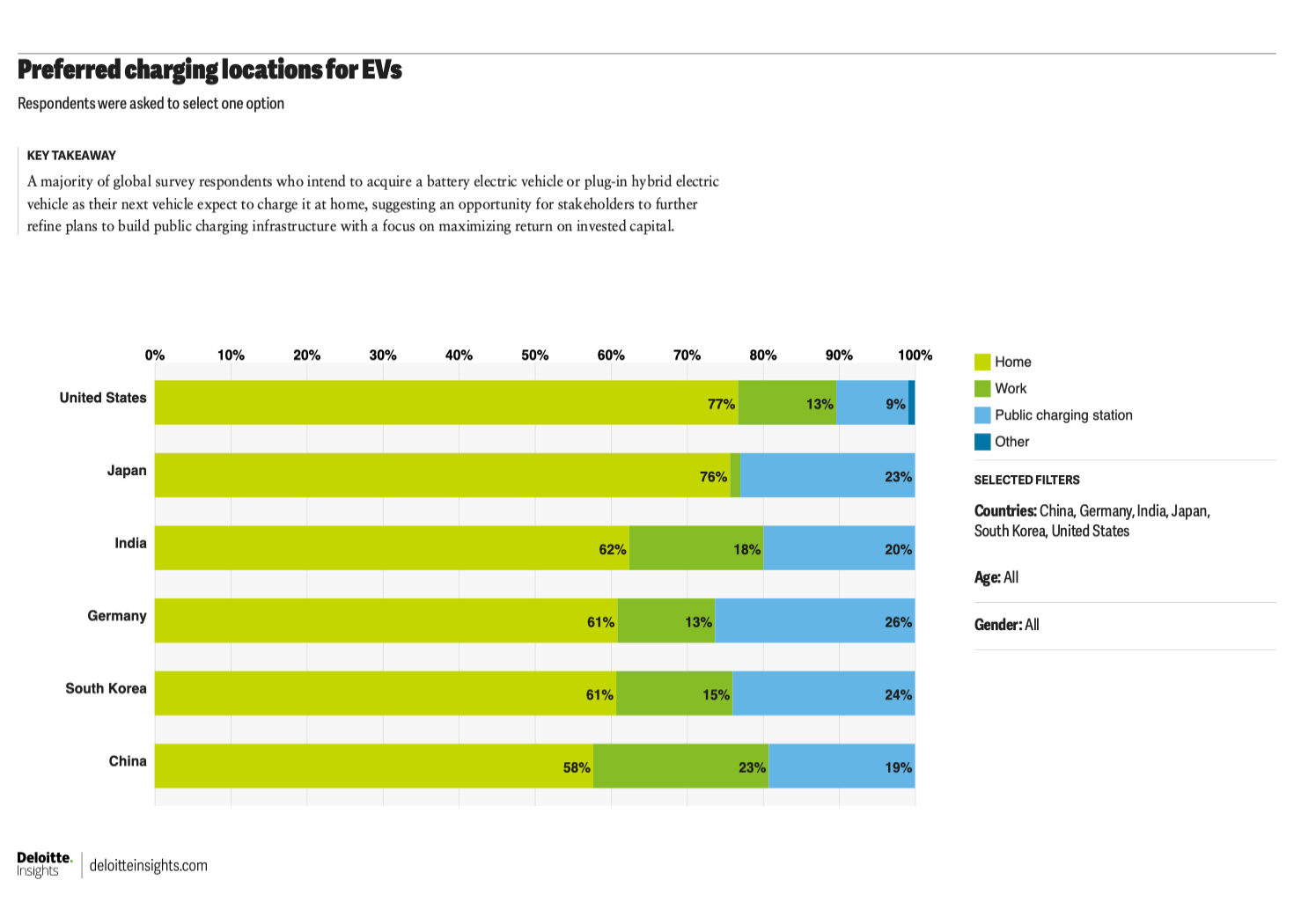
A graph showing car buyers' favorite charging locations.
Credit: Deloitte
While reliable charging in the workplace – emphasis on trustworthy– can compensate for not being able to charge at home, 77 percent of US car buyers said they would prefer to charge at home (while only 13 percent said they would prefer to charge at work).
Why choose an EV?
For people who haven't yet decided to make the switch, an underappreciated fact is how much more efficient an electric powertrain is compared to one that burns liquid petroleum. Ford's experiment to put an electric powertrain in its best-selling F-150 pickup may have failed, but consider this: The V6 truck requires more than three times as much energy to travel 310 miles as the one you plug into a wall socket, considering that a gallon of gasoline contains 33.7 kWh of energy.
This is probably old news among EV believers. More than half (52 percent of U.S. respondents) said lower fuel costs were a reason for choosing an electric car, beating out environmental concerns, which came in second at 38 percent. And between $20,000 and $49,999 seems to be the best price, with 24 percent looking for something between $20,000 and $34,999 (cars like the new Nissan Leaf or the soon-to-be-reborn Chevrolet Bolt) and another 24 percent looking for something between $35,000 and $49,999, with many electric cars to choose from, including the efficient new CLA from Mercedes-Benz.
Only seven percent of those EV buyers want to spend more than $75,000 on their electric car, but luxury EVs are plentiful in this price range.
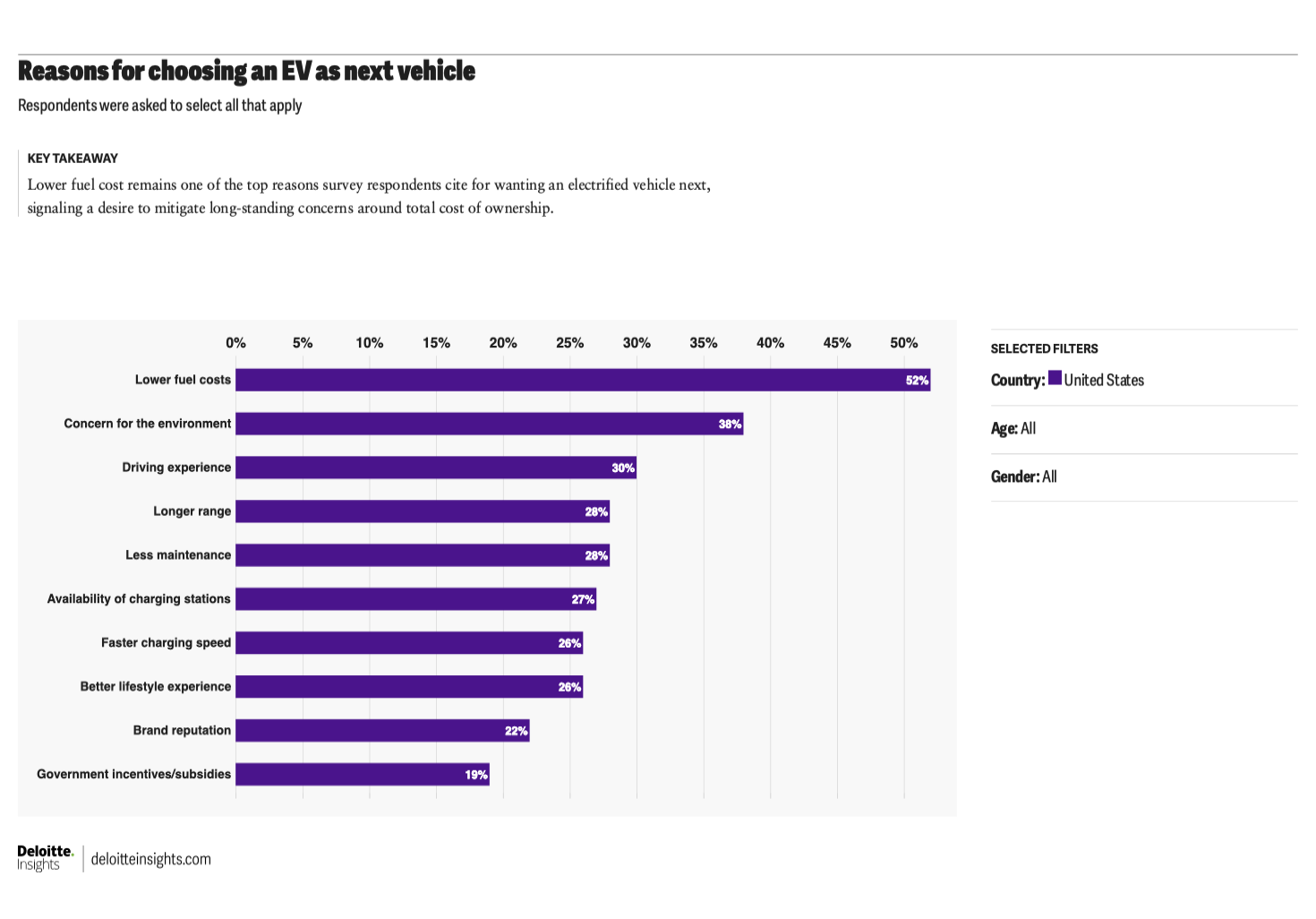
A graph showing American car buyers' reasons why their next car would be electric.
Deloitte
A graph showing American car buyers' reasons why their next car would be electric.
Deloitte
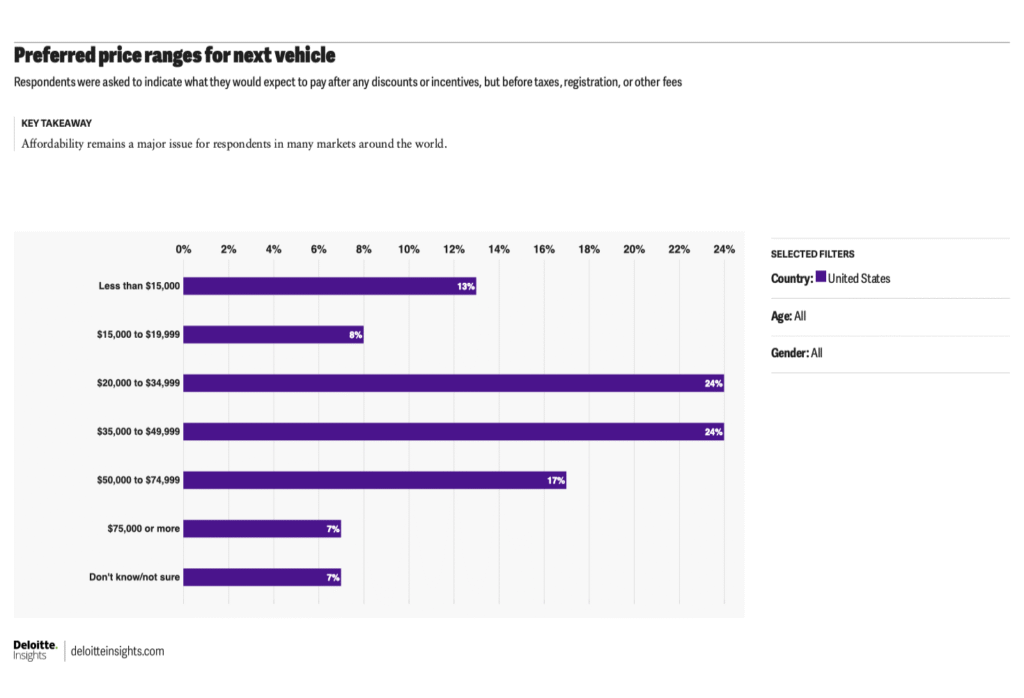
A chart showing the preferred price ranges for US EV buyers.
Deloitte
A chart showing the preferred price ranges for US EV buyers.
Deloitte
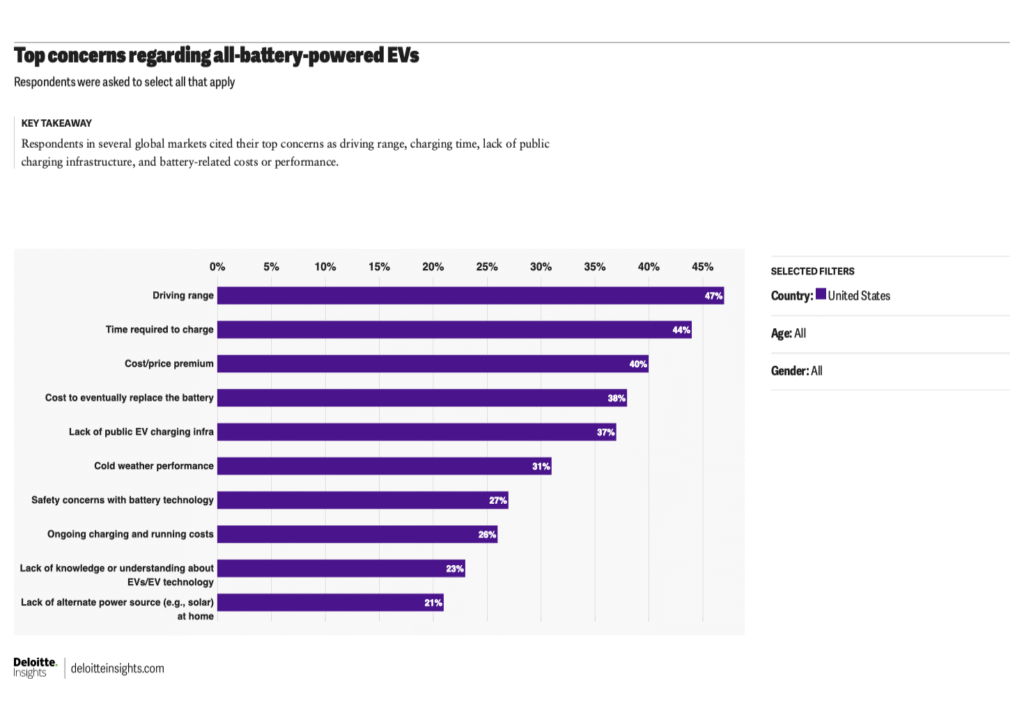
A graph showing US car buyers' concerns about electric vehicles.
Deloitte
A graph showing US car buyers' concerns about electric vehicles.
Deloitte
A chart showing the preferred price ranges for US EV buyers.
Deloitte
A graph showing US car buyers' concerns about electric vehicles.
Deloitte
Meanwhile, range and charging times remain the top concerns among car buyers when discussing electric vehicles, along with the cost premium. However, some other fears are unfounded. Thirty-eight percent said they were concerned about the cost of eventually replacing an electric car battery. But EV batteries are proving to be more durable on the road than many early adopters once believed. There is little evidence that EVs will require costly battery replacements at a greater frequency than older cars require new engines, a concern rarely mentioned when someone wants to buy a gas-powered machine.
The US doesn't care about software-defined vehicles
One of the biggest shifts in automotive design and production in recent years has been the advent of the software-defined vehicle. Until now, virtually every electronic function in a car, from power windows to anti-lock braking, has required its own electronic control unit. Some cars can have up to two hundred separate ECUs, some with software that dates back years.