
Financial pressure and a changing tune
OpenAI's advertising experiment reflects the enormous financial pressure the company is facing. OpenAI doesn't expect to be profitable until 2030 and has committed to spending about $1.4 trillion on massive data centers and chips for AI.
According to financial filings obtained by The Wall Street Journal in November, OpenAI expects to burn about $9 billion this year while generating $13 billion in revenue. Only about 5 percent of ChatGPT's 800 million weekly users pay for subscriptions, so it's not enough to cover all of OpenAI's operating costs.
Not everyone is convinced that ads will solve OpenAI's financial problems. “I am extremely bearish on this advertising product,” technology critic Ed Zitron wrote of Bluesky. “Even if this becomes a good business line, OpenAI's services cost too much to matter!”
OpenAI's embrace of advertising appears to come reluctantly, as it runs counter to a “personal bias” against advertising that Altman has shared in previous public statements. For example, during a fireside chat at Harvard University in 2024, Altman said he found the combination of ads and AI “extremely disturbing,” implying that he wouldn't like it if the chatbot itself changed its responses due to advertising pressure. He added: “If I think about GPT writing me a response, and I would have to find out exactly how much who pays here to influence what is shown to me, I don't think I would like that.”
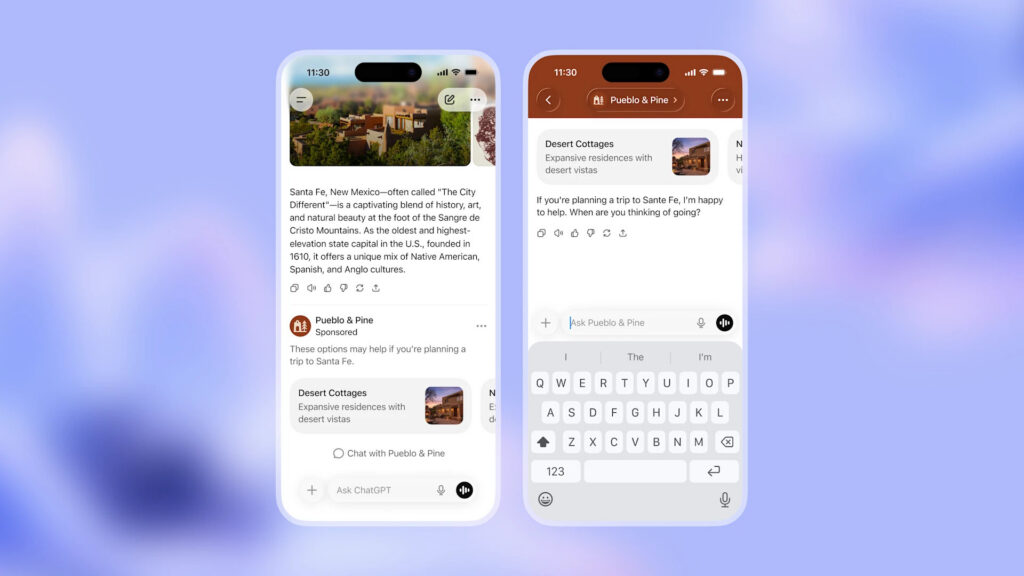
A sample ad mockup in ChatGPT provided by OpenAI.
A sample ad mockup in ChatGPT provided by OpenAI.
Credit: Open AI
In that sense, OpenAI's approach seems to be a compromise between needing ad revenue and not wanting sponsored content to appear directly in ChatGPT's written responses. By placing banner ads at the bottom of replies, separated from conversation history, OpenAI appears to be addressing Altman's concern: the AI assistant's actual output, the company says, will not be influenced by advertisers.
Indeed, Simo wrote in a blog post that OpenAI's ads will not affect ChatGPT's conversation responses and that the company will not share conversations with advertisers or show ads about sensitive topics such as mental health and politics to users identified as under 18 years old.
“As we introduce ads, it's critical that we preserve what makes ChatGPT valuable in the first place,” Simo wrote. “That means you have to trust that ChatGPT's responses are driven by what's objectively useful, and never by ads.”